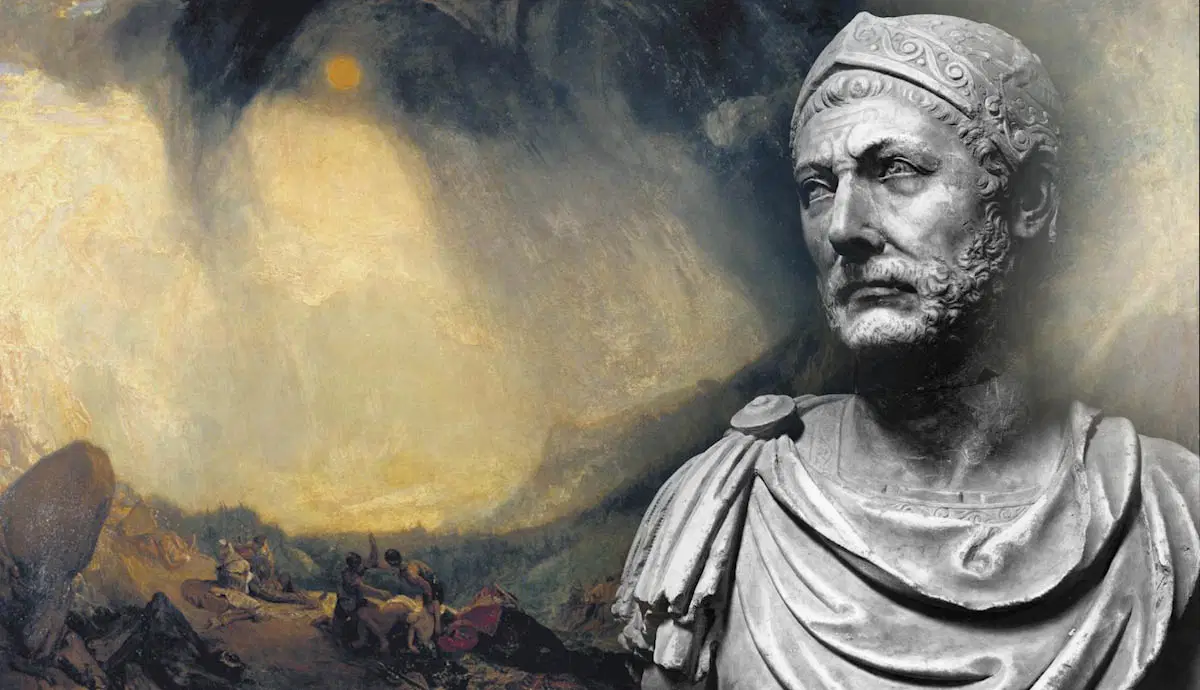
Part 11 of 12 – Hannibal Returns to Carthage (206 – 202 BC)

In 206 BC Hannibal sits in the boot of Italy watching his grip on the Peninsula slide further out of his grasp. His veteran army can still match any Roman force but after so many years of combat the number of men pledging loyalty to Hannibal dwindles. He’s surrounded by Roman armies. They won’t confront him but they make sure Hannibal can’t move anywhere. Hannibal agonizes over the fact that he has no option but to be a spectator in the war he started. His men hold the small region of Bruttium. The rest of Italy is firmly in Roman hands.
Hannibal and his men are worn down. They know the end is coming. They’ll soon have to leave the place where they made history together. As Hannibal enters his 40’s he grows tired. More often than not he finds himself confronted by younger, more risky generals who remind him of himself at their age.
Not much is known about Hannibal’s final years in Italy but no major battles seem to be documented. Hannibal and his men had little more to do than await the outcome of Scipio’s war in Spain.
Scipio Wins the Battle of Ilipa, the Noose Around Hannibal Tightens

The Romans have directed their war effort to seizing Spain from Carthage. This effort is led by Scipio who at 30 is one of the youngest Proconsuls in Roman History.
After defeating Hasdrubal Scipio engages Hannibal’s youngest brother, Mago. He lays waste to all Carthaginian forces he encounters. He emerges victorious everywhere his armies fight. His status as the Roman answer to Hannibal spreads throughout the homeland. Already, he’s being branded by many as Rome’s Hannibal.
Beyond warfare he’s also well-versed in diplomacy and convinces more of Carthage’s allies to flock to him. Many do and the Carthaginian hold on Iberia shrinks. Propaganda and lore will during his time and for centuries to come propagate Scipio as the savior who arose at the right moment to prevent Rome’s destruction.
In 206 BC Scipio wins a decisive battle near Seville in southern Spain despite being outnumbered 2 to 1. Like Hannibal, he artfully achieves his impressive victory through highly intelligent yet unorthodox means to chip away at, confuse, and then route a much larger foe. The Battle of Ilipa is sighted by many as Scipio’s greatest performance. The Carthaginian hold on their most prized possession hangs by a thread.
Carthage Loses Spain, Hannibal is Finally Recalled
Mago flees Iberia, and by the end of 206, all of Carthage cedes Iberia to Rome. Rome is in control of the seas, the islands between Italy and Africa, and now Spain. And Hannibal is confined to a small portion of Italy. This means Carthage is vulnerable to a Roman invasion.
in 205 BC Scipio leaves Iberia and heads back in Rome to orchestrate an invasion of Africa. Scipio means to thoroughly punish Carthage. But no doubt his choice to focus on Africa and ignore Hannibal who still roams the countryside is meant to slight to the Carthaginian. Hannibal must have been frustrated. Rome mounts an invasion force in Sicily and he can do nothing but watch.
In 204 BC Scipio sails to Sicily to oversee preparations for the pending invasion. Soon Hannibal will need to go home so he can defend against the very thing his invasion of Italy 14 years ago was meant to avoid.
Why Hannibal’s Legendary Invasion Failed

After a battle like Cannae, most nations in antiquity would have sued for peace. Rome didn’t. This is what separates them from everyone else. Rome never contemplated ending hostilities with Hannibal, even with his foot on their throat. That iron will, that resolve is what carried Rome through its darkest moment.
To combat the invasion, Carthage recalls Hannibal. He must return home. In 203 BC Hannibal leaves Italy for good. So in the end it is he, not the Romans who must retreat. Hannibal is 44, it’ll be the first time he sets foot on African soil since he was a boy. He’s a man who dedicated his life to war. He’s never known any other life.
Scipio Invades Africa (204 BC)

Scipio Africanus lands on the coast near Utica, about 25 miles from Carthage with around 30,000 troops. He advances south toward the city of Tunes (modern Tunis) which he eventually captures. Carthage fears that Scipio’s next step will be to lay siege to its capital. The people cry for their hero to save them.
Hannibal Sails Home, Prepares for the Defense of Carthage
When Hannibal departs Italy he docks his ships east of Carthage. With his nation in crisis Hannibal suspects that while the people love him, the politicians might use him as a scapegoat. Already he hears reports that the Senate is negotiating peace talks with Scipio in his absence.
Consternation between Hannibal and Carthage’s ruling class have always been rumored. The Senate never authorized Hannibal’s ambitious invasion of Rome back in 218 BC. And they never seemed to prioritize his campaign in Italy as they frequently sent the reinforcements Hannibal needed to Spain instead. Part of this could be due to Carthage caring more about holding its territories in Spain than bringing Rome to heel. Another factor could simply be profound jealously felt toward Hannibal’s achievements. And now that Carthage faces the very real horror of Roman revenge, Hannibal grows wary of wandering too close to his home city. He doesn’t rule out that the senate, in a heightened state of panic, might hand him over to the Romans as they absolve themselves of responsibility for this war.
Hannibal spends the year 203 BC building up his forces as Carthage begs Scipio to consider a peace deal. However when the people of Carthage learn that the mighty Hannibal has returned they throw an uproar and demand a showdown between their greatest general and Scipio before agreeing to peace terms they know will be punitive.
Eventually word reaches Hannibal to the East beseeching him to rescue Carthage. Hannibal responds in the affirmative. But instead of moving directly to the city, he leads his army further inland to a town called Zama.
Hannibal and Scipio: A Historical Encounter
Despite his hatred of the Romans Hannibal recognizes the genius in this new foe. He knows the young Roman general will challenge him as none have before. When Scipio’s army sets up camp at Zama, Hannibal does something he’s never bothered to do before. He requests a meeting with the Roman protégé. And to his surprise, Scipio accepts. Perhaps this indicates that despite being polar opposites, the two can’t help but be somewhat fascinated by the artistry and legendary nature of the other. It’s rare in history for two colossal talents to face off against one another.

Both generals put their armies in position and then they each gallop to see the other in person alone. The two men size each other up. Hannibal makes a half-hearted effort to persuade Scipio to leave Africa. Scipio refuses. He passionately informs his teacher that it is he who now holds the cards. Scipio intends to make Carthage a vassal of Rome unless Hannibal can stop him here. Each man knows that battle is inevitable. Both men walk away with nothing to show from this otherwise historical encounter.
The Battle of Zama (202 BC)

The next day the two generals line up their men. The battle that’s about to transpire will determine the fate of the two largest empires in the Mediterranean. Hannibal and Scipio are both undefeated. Yet Hannibal holds a decade of experience over his foe.
But much has changed since the time when Hannibal’s prowess made him Godlike in the eyes of his enemies. Carthage has lost much prestige since the war’s outset and most of its allies, including the incredible Numidian Horsemen, have flocked to the Romans. Now it’s Rome with the superior cavalry.
Scipio is in his fighting prime. those close to Hannibal on the other hand comment on how much those years of fighting and surviving in hostile enemy territory have taken its toll. He’s low in energy, weathered, physically much less able than in his younger years.
This Roman army is superior to Hannibal’s. The only advantage that cuts toward the Carthaginians is they outnumber the Romans in infantry. Sources estimate around 40,000 Carthaginians stand before 30,000 Romans. Hannibal also has 80 war elephants in hand.
The tense silence is broken when both generals send out their cavalry first. The Romans easily best the Carthaginian cavalry. When the infantry lines clashed in no man’s land fierce fighting erupts. The men battle with everything they have. Everyone understands the stakes involved. But no side gains the upper hand.

Hannibal unleashes his war elephants but Scipio orders his soldiers to form rows with gaps inbetween. The elephants charge right through the open aisles. They harm no one and run off in confusion.
Despite the elephants ineffectiveness, sources say that at this point Hannibal’s infantry is thwarting Rome’s. They seem to have the upper hand. Will Hannibal’s glorious career grant him one more victory? Unfortunately for him, Scipio is unlike any general he’s fought. Scipio unleashes a concealed wing of his cavalry. Thousands of unseen riders charge Hannibal’s men from behind. The perfect execution of a classic Hannibal move. And now it’s Hannibal who stares in dismay as the Romans surround his men. He can do nothing as the Roman’s cut down every Carthaginian in sight. It’s a sickening display of karma for the general. The conflict ends in disaster. Rome winds a resounding victory.
Scipio is the first and only Roman general to ever best Hannibal. Carthage’s once great hope, and now their last chance has been checkmated. After the carnage at Zama, Carthage has no choice but to surrender. Thus in 202 BC the 2nd Punic War comes to an end 16 years after it began.
Concluded in Part 12…
Timeline
206 BC – Hannibal consigned to hold up in Bruttium
206 BC – Scipio wins the Battle of Ilipa, effectively crushing the Carthaginian presence in Spain
204 BC – Scipio invades Africa, lands in Utica
203 BC – Hannibal Sails home, abandons Italy forever
202 BC – Scipio defeats Hannibal at the Battle of Zama, ending the 2nd Punic War
If you want to learn more about Scipio Africanus and the 2nd Punic War then please read Scipio Africanus: Greater than Napoleon by B.H. Liddell Hart and Capt. B.H. Liddell Hart
Want more history? Check out my other blog posts right here!