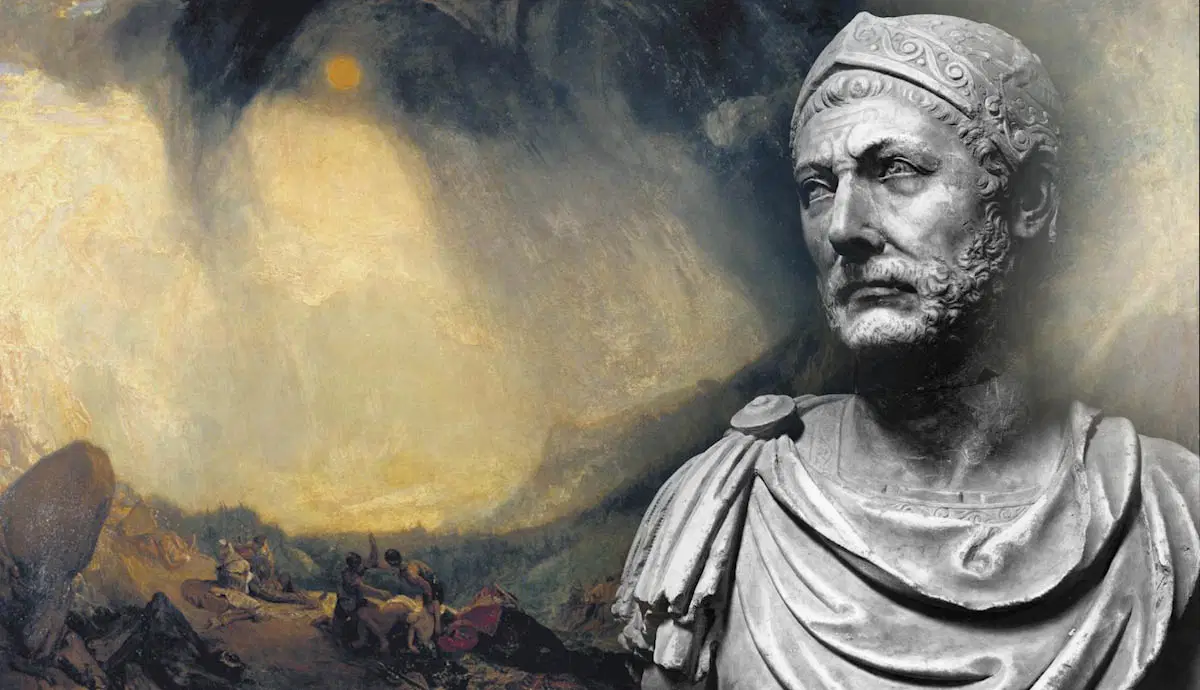
Part 12 of 12 – Hannibal – The Wandering Hero (201 – 183 BC)
In 201 BC Carthage is forced to give up its power, and its territory outside the immediate area of Carthage. They are no longer a power to be reckoned with. Carthage decides it is better to acquiesce to these humiliating terms to prevent Scipio from laying siege to Carthage. However they are now nothing more than a shadow of their past self. They will never contend for legitimacy in the Mediterranean again.
Hannibal the Statesman

What happens to Hannibal? The 46 year-old steps away from military life and enters politics. He becomes a statesman in Carthage. Hannibal as chief magistrate oversees the city’s finances. He turns out to be pretty successful as well. He facilitates a well-structured financial plan for the city to pay the incredible indemnity they now owe Rome without raising taxes on a single Carthaginian. Hannibal also uses legal pressure to stamp out embezzlement, fraud and racketeering, which turn out to be a huge problem in the city.
However this gets him into trouble with the Oligarchical families, many of whom are the proud beneficiaries of the financial corruption. Hannibal also pushes through amendments to the electoral process to give the average citizen more of a voice and to curtail the aristocracy’s influence. The Oligarchs don’t particularly appreciate being held accountable, and a rift between them grows. Rome, who still fears Hannibal, takes advantage of that rift. 7 years after the battle of Zama, Rome decides it is not comfortable with Hannibal living in the vicinity. Plus Carthage is experiencing a financial and cultural renaissance, so they pressure Carthage to expel the great general. Hannibal, to his credit, leaves Carthage before the Oligarchs have the chance to exile him.
Hannibal in Exile

In 195 BC Hannibal, aged 53, travels east. He spends some time in the island nation of Tyre off the Israeli coast, then he moves further east to Ephesus, a southern region of Turkey. He’s welcomed there as an honored guest by their king, Antiochus. But during the 5 years Hannibal is there, tensions mount as the Romans press their territorial expansion eastward. Without Carthage, Roman reach will explode at a rapid fire pace over the next century. And by 190 BC Rome is at Ephesus’s doorstep. King Antiochus places Hannibal in charge of his navy, which Hannibal must construct from scratch.

Hannibal builds the navy, and he’s granted a new title, that of Admiral. But his first battle at sea doesn’t go well and he’s defeated. This defeat gives the Romans full control of the Aegean sea. Antiochus is now reduced to a vassal of Rome. He’s ordered to hand Hannibal over. To prevent this, Hannibal flees north east to Bythinia. It’s a region of Turkey that hugs the Black Sea. It is here that Hannibal will enjoy one final hurrah.
Hannibal’s Final Victory

In 190 BC the 57-year-old Hannibal finds himself surrounded by a fleet of warships belonging to a key Roman ally. Hannibal’s brain conjures a magnificent trick to save his crew, reminiscent of his old uncanny ability to surprise the enemy through unusual means. He reportedly fills clay pots with venomous snakes and lobs them onto the enemy vessels. The men aboard open the clay posts and laugh at the snakes… until they begin to bite. The unorthodox gamble works as the snakes clear the Roman fleet. It’s another victory for Hannibal, who is well past his prime but still proves to be someone you battle against at your peril.
However the broader narrative remains unchanged. Hannibal’s wins don’t arrest the greater Roman war machine. Rome is too large, too powerful, and no single individual can stop them from consuming land.
Bythinia eventually falls into Roman hands in 184 BC. Once again the Romans demand that they give up Hannibal.
Hannibal’s Death

Hannibal flees Bythinia and hauls himself inside a Turkish Castle. The Romans are hot on his heels. Legend states that Hannibal discovers one night that he’s surrounded by Romans. the Roman historian Livy claims Hannibal would rather die than become Rome’s prisoner, which would entail being chained and paraded through the streets of the Capital. To avoid this humiliating display, Hannibal pours poison down his throat and passes away shortly thereafter. Thus ends the life of one of history’s most monumental and towering figures. The precise date of his death is unknown. It’s believed to have happened between 183 and 181 BC, making him somewhere between 64 and 66 years old.
Hannibal’s Legacy – Rome does not Forget

“He had indeed bitter enemies, and his life was one continuous struggle against destiny. For steadfastness of purpose, for organizing capacity and a mastery of military science he has perhaps never had an equal.”
- Maximilian Otto Bismarck Caspari, 1911
When Hannibal was in exile he supposedly ran into Scipio, who was serving a diplomatic mission for Rome. They happened to be guests at the same dinner. They discussed warfare of course. Scipio supposedly asked Hannibal who he considered the 3 greatest generals to be. Hannibal named Alexander the Great. Scipio agreed. Hannibal then named Pyrrhus as his choice for 2nd best. Hannibal might have been sincere in this answer, but given that Pyrrhus famously defeated the Romans many times It might also been a passive slight to Scipio. Hannibal then claims himself as the 3rd best general in history. Scipio laughs at this. He asks how Hannibal can rank himself above Scipio, who after all bested him in the end. Hannibal says “If I had bested you, I would have to place myself above Alexander.”
Hannibal would live in the mind of Rome for the rest of its existence. In time many Romans came to admire Hannibal, who they saw as a worthy adversary. However Rome’s very survival would not fall into serious doubt again for another 600 years.
But Hannibal caused great distress to many in Roman society. His name invoked so much terror that Romans would exclaim “Hannibal ad portas” (“Hannibal is at the gates!”) to emphasize the gravity of an emergency.
Rome could never shake the nightmare of Hannibal. So not even 40 years after Hannibal’s death. Rome declared war on Carthage once again. The declaration was wholly unprovoked. At this time Carthage posed zero danger. But it didn’t matter. The trauma caused by Hannibal created a wound that that would never heal. Rome couldn’t reign in peace while Carthage existed.
The 3rd Punic War – the End of Carthage (146 – 149 BC)

The 3rd Punic war was less of a war and more of a campaign of annihilation. Roman armies invaded Africa. They laid siege to Carthage. They eventually took the city and razed it to the ground. They massacred the population and turned the once vibrant city into a wreckage of smoldering ash. The cold brutality of this “war” even scared many of the Roman generals involved who supposedly wept upon watching the carnage unfold. One Roman general claimed that this was how all great empires come to an end, and this too will be Rome’s fate.
But that day was far in the distance. Rome was entering its prime. Rome would spend the next 2 centuries building one of the largest and most powerful empires in history.
Carthage was left as a pile of ash until the reign of Augustus, Rome’s first emperor. He resurrected a new city over the ruins of the old, which he dubbed Karthago.
Hannibal lost, but through his exploits he carved himself a space in the eternal memory of mankind.
Timeline
201 BC – Carthage and Rome finalize post-war peace terms
195 BC – Hannibal flees Carthage, heads to Turkey in exile
190 BC – Hannibal’s navy loses to the Romans and Rhodians at the Battle of Side
190 BC – Hannibal defeats a Roman allied navy by throwing clay pots filled with venomous snakes onto the ships
181 – 183 BC – Hannibal poisons himself and dies to avoid Roman capture
146 BC – Rome destroys the City of Carthage
If you want to learn more about the 2nd Punic War then please read The Fall of Carthage by Adrian Goldsworthy
Want more history? Check out my other blog posts right here!
I loved all 12 episodes! Hannibal will remain a “larger than life” figure in all the history books forever. Simply fascinating, well done!
Comments are closed.