Part 2 of 12
To understand Hannibal’s role in the great conflict between Rome and Carthage we need to roll back time to the war that creates the world Hannibal will inherit. 17 years before Hannibal is born, Carthage and Rome clash over control of the central Mediterranean. The catastrophic event sets the wheels in motion for the second conflagration that will destroy Carthage and solidify Hannibal’s legend.
Carthage and Rome Meet for the First Time
Very few see the thundering clouds gather over the horizon in the early decades of the 3rd century BC. When Rome and Carthage first come into contact their relations are friendly at the outset and they even form an alliance. But that partnership is predicated upon a common interest when they are suddenly confronted with a new and powerful enemy.
Introducing Pyrrhus, King of Epirus

In the early 280’s BC Roman armies aggressively push into Southern Italy. A region is home to many Greek city states. They encompass the remaining vestiges of an Italy still free from Roman rule. They dread the rapid encroachment of Roman infantry and because they are no match for the marching behemoth so they send a distress signal to Greece begging for reinforcements.
That support arrives in the form of Pyrrhus. He is known as a dynamic king with genius and cunning. He co-reigns in Epirus, a Greek polis in modern day Albania right across from Italy. The King heeds the call and invades the Italian peninsula with an army 20,000 strong. This marks the first time the world of Hellenism and Rome collide. Pyrrhus lives up to his reputation and defenestrates the formidable Roman army twice in battle. But victory comes with a heavy cost. Pyrrhus’s losses are so staggering that he chooses to dismiss further engagement with Rome. Historical record stipulates that after winning the second battle Pyrrhus remarks, “If we are victorious in one more battle with the Romans, we shall be utterly ruined”. Thus coining the term “Pyrrhic victory.”
Pyrrhus abandons Italy and decides to try his luck against Carthage. In 278 BC, Carthage occupies the western half of the island of Sicily. They decide to press their imperial aims so they lay siege to the city of Syracuse. The Syracusans are no match against the North African naval and land power. But good fortune breaks in their favor as Pyrrhus answers their call for help. Pyrrhus easily dismisses the Carthaginian siege. Pyrrhus then defeats the Carthaginians in several follow up clashes. They perform much worse against the wily King than their Roman counterpart. But Pyrrhus depletes his resources so he can no longer sustain his war efforts. He has no choice but to resign and abandon Sicily. Carthage regains supremacy over much of the island.
But Pyrrhus’s appetite for spilling blood is not yet satiated. Instead of returning to his homeland he boldly decides to launch one more crusade against Rome.
Carthage and Rome Form an Alliance

This is the moment when Rome and Carthage first meet. Two thriving super powers eager to dispatch a shared enemy. They form an alliance promising to assist each other in their war against the Greek King. The overwhelming might of their combined strength gives Pyrrhus the boot. Despite his impressive victories against superior enemies his achievements amount to very little. In 275 BC Pyrrhus sails home empty handed.
Hostilities cease and a tentative peace ensues. But what little there is upholding the alliance starts to dissolve. Rome and Carthage are now eying each other with wariness and apprehension. The writing on the wall becomes apparent to some. As Pyrrhus departs he delivers a chilling and prophetic statement, “what a battlefield we are leaving to the Carthaginians and the Romans.”
The next 11 years pass quietly but decades of imperial expansion nullify the fragile truce now that Rome and Carthage are rubbing shoulders. And in 264 BC the two empires go to war. The conflict erupts over control of Sicily. To both sides the coming conflict feels inevitable. But just as the young men and boys who marched into the trenches of the First World War had no clue what they were getting into; neither Rome nor Carthage foresees the horrific maelstrom they’ve created.
Carthage and Rome at War

The First Punic War begins as a clash for control of Sicily. It’s unclear which party draws first blood but historians point to Rome as the aggressor. This is Romes first military venture outside of Italy. They field the finest land army in the Mediterranean but Carthage is by far the superior naval power. Carthage is also the more established super power. Their industrial output exceeds Rome’s. Their naval supremacy allows them to import essential goods, food, and war materials from all over the Mediterranean.
But Rome is ascending and they are undeterred. War with Carthage presents them with a challenge they are willing to accept. They want more land, more power and they will stop at nothing to get it. War is enmeshed in Roman DNA. Rome is an unstoppable force that overwhelms their enemies with unrelenting pressure. A battering ram that pounds its enemies into submission.
Another component that separates Rome from other nations of antiquity is their iron will to win, and their stubborn refusal to throw in the towel. It is customary for nations to raise the white flag once war turns sideways. The same cannot be said of Rome. Their ethos is to never yield. To never fall back. They absorb military defeats in stride. If they lose an army they simply produce another army and try again.
Carthage does not share this mindset. Falling in line with their contemporaries, they don’t care to waste money and time and lives to see how far they can press their imperial aims. Carthage will only tolerate a finite number of defeats before seeking peace. It is this difference in mindset that gives Rome the advantage in their first war. Rome will adapt as needed so they can turn their most glaring weakness into a strength. So while Carthage makes no effort to strengthen its land army, Rome builds a navy.
Rome Seizes the Initiative

Rome springs into action and amasses a fleet of battleships in very short order. Their warships number in the hundreds. They use a captured Carthaginian ship as a guide to design their oared boats. Lucky for them, that Carthaginian ship is a brand new model knows as a quinquereme. The Romans fashion their own fleet on this new edition but they add a slight but significant modification. Their creation includes a “corvus.” A small wooden bridge to the ships deck. It allows Roman soldiers to board an enemy ship where they can skirmish above deck, in the style of a land battle.
The First Punic war morphs into a large scale naval conflict. With hundreds of ships engaged on both sides it is considered to be the largest naval war ever fought to this day. Rome’s ingenuity in how it constructed its new fleet pays dividends. The Romans enjoy scores of victories over Carthage in the early years of the war. In 262 BC, 2 years after the fighting commences much of Sicily along with its prized jewel Syracuse fall into Roman hands. large sums of money and goods flow into the city of Rome. They could have bartered for a truce here but Roman ambition knows no bounds. The Romans decide to shift their focus south to very heart of Carthage’s empire. They will invade Carthage itself. But if they want to land an army on the shores of North Africa they need to first clear the way.
In 256 BC, eight years after the war began, a Roman fleet of 320 warships attacks a Carthaginian armada of 350 decked ships. This colossal battle kicks off along the southern coast of Sicily. The sheer number of men involved in what is called the battle of Ecnomus is astonishing. Conservative estimates guess 250,000 men participate in the fray. That figure makes this the largest maritime battle ever fought, even to this day.
The end result is victory for the Romans. The seas to Tunis are now open. And in the following year tens of thousands of Roman troops land on Cap Bon, roughly 75 miles northwest of Carthage. The Romans fight their way south east toward the prized city. A Roman army of 15,000 men is just 10 miles from the Capital. The Romans are about to unleash the final blow. But it never comes. They are instead hacked to pieces by a Spartan force that arrives at the midnight hour to save Carthage with whom they are allied. The Spartans vanquish the Roman foothold in North Africa.
The setback for Rome is severe, but it does little to deter their war effort. The Romans tighten their grip around Sicily. But the defeat frustrates their momentum and it reinvigorates Carthaginian spirit. They start winning naval battles and the war descends into a grueling stalemate. Each nation spends the next 14 years locked in a dire game of tug of war. It will test their resolve as they look for an opportunity to pounce.
Thus Enters the Barca Family
After Rome’s dramatic setback at the outskirts of Carthage, Sicily once again becomes the focal point of this conflict. Battles rage all around the island and on the island as well. In 247 BC, after 17 years of war Carthage sends one of their new and esteemed generals to command a force in Sicily. His name is Hamilcar Barca. Around the timing of this appointment Hamilcar’s wife gives birth to their son. They name him Hannibal.
Ancient sources describe Hamilcar as a distinguished tactician. He possesses a flair for the unorthodox. A skill almost certainly inspired by Alexander the Great. His unconventional approach to warfare will win him many battles and cement him as Carthage’s best general in the First Punic War.
Hamilcar chooses to avoid meeting the Romans in open field. He conducts expertly timed hit-and-run attacks against smaller contingents. Hamilcar ambushes packs of Romans at the periphery and avoids confronting the main body. He also develops a knack for savaging Roman supply lines and places tremendous financial burden on Rome. The key to his victories is his ability to move his army with uncanny speed and unpredictability. His reputation spreads and his name stokes fear into the Romans. Hamilcar introduces a new kind of guerrilla warfare that they have never before experienced. They don’t know how to respond and Hamilcar seems to be everywhere and nowhere. Hamilcar establishes himself as Carthage’s best general of the First Punic War. He never loses a battle.
Hamilcar’s success on the field bolsters moral at home. However, his victories are rather small in stature and they do little to shift the larger tides in favor of Carthage. The main problem is Carthaginian leadership and their inability to properly coordinate such a massive conflict. At no point during the 23 year war does the ruling class ever manage to organize their land and naval forces into a cohesive campaign. Their lack of wider planning gives Rome and final advantage and becomes the final nail for Carthage.
An Ignominious End to the First War Between Rome and Carthage
The war ends in 241 BC when the Romans beat the Carthaginians at sea in one final grandiose conflagration. Carthage as a nation bends but far from broken but they decide to sue for peace as they’ve simply had enough. Thus after 23 years the First Punic War comes to a rather anticlimactic end.
The vast scope of the conflict strained both sides to their breaking point. The result leaves both nations in near financial ruin. They have eaten through all their reserves. And their armies pushed to the brink of exhaustion. The war cost hundreds of thousands of lives; essentially wiping out 2 generations of young men. A staggering sum unheard of in antiquity. Victory feels hollow for the Romans as it would for the Allied Powers after World War I. In the end, Carthage fails because of poor planning, underestimating Rome’s strength at sea and for not possessing Romes iron will to fight to the bitter end. The First Punic War ends with a whimper as a result.
Carthage appoints their best general Hamilcar to negotiate an armistice with Rome. He tries his best to secure favorable terms but the Romans are not in a generous mood. Rome forces Carthage to give up all of Sicily, as well as Sardinia. Carthage must also pay the Romans a monumental sum to cover its accrued debts. Carthage loses vital trading routes and is reduced significantly as a power in the Mediterranean. Hamilcar signs the final treaty since he has no other choice and Carthage’s empire as well as its prestige are thoroughly diminished. Carthaginian sentiment quickly becomes acidic and bitter. Hannibal is 6 years old.
Introducing Hannibal Barca
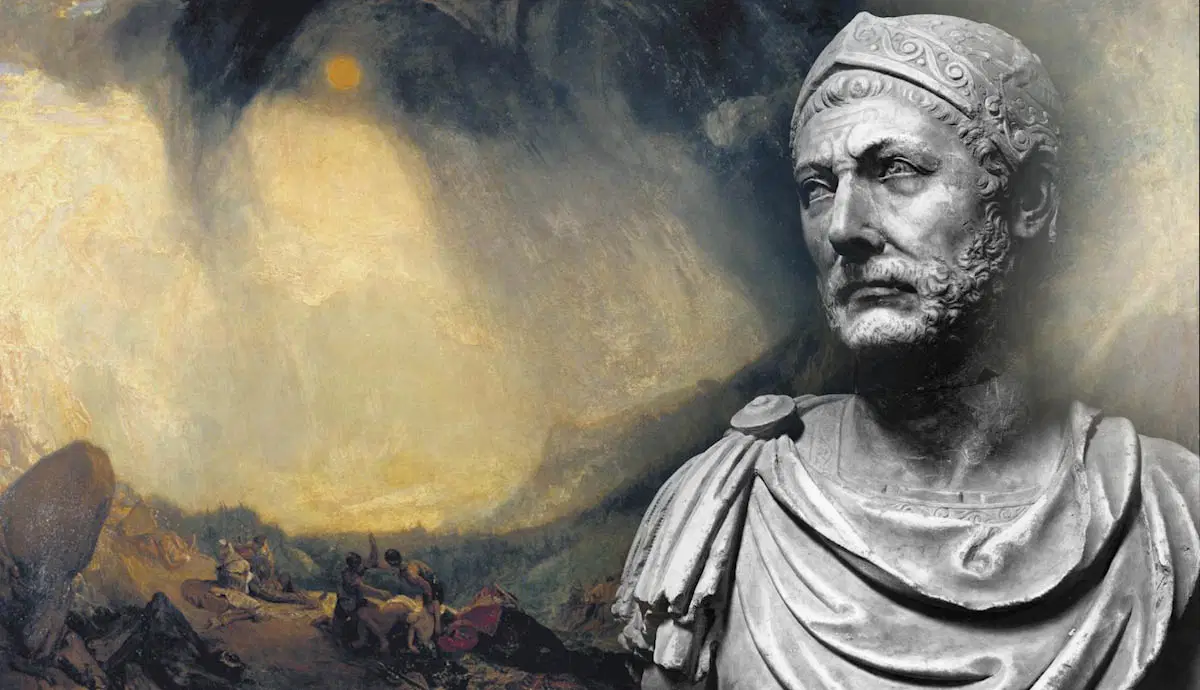
Hannibal’s name translates to “he who finds favor with Ba’al,” the chief God in Carthaginian myth. Hannibal is born in 247 BC to Hamilcar. Nothing is known of his mother. He is the oldest of three brothers, the younger are Hasdrubal and Mago. He has at least three sisters but little is known of them. Hannibal spends his formative years in the city of Carthage while his father battles the Romans in Sicily. Because of his father’s service he never sees Hamilcar until he return after the war. He is five or six-years-old when news of the humiliating peace treaty arrives.
Hannibal is part of a generation of children who grow up never knowing the Carthage that their parents and grandparents knew. They listen to tales of their empires former glory and how it served as a hub of power, culture, and sophistication. But now the Carthage Hannibal sees is one of sadness, frustration, resentment, and chaos.
The Carthaginians are outraged that the ruling oligarchs yielded the war and allowed Rome to carve their empire, and seize their overseas assets. They believe they should have won the war. And could have if not for the incompetence of the ruling class permeates all corners of the city. Hamilcar instils in Hannibal and his brother’s antipathy towards not only Rome but the leaders of Carthage who lost the war because of gross ineptitude. This argument has merit. Carthage could have pressed on if it possessed the will, unlike the germans who falsely claimed they could have beaten the Allies in the aftermath of World War I.
There is little peace in post-war Carthage. The atmosphere becomes acidic and turbulent. The city suffers from financially bankruptcy. It cannot afford its assigned payments to Rome. As the economy worsens, the fabric of law and order continues to rupture. Violent protests ring through the streets. Veteran soldiers and mercenaries demand compensation for their valor and service. But the vaults empty. The oligarchs can give nothing. The situation deteriorates and public disarray devolves into civil war. And It appears that Carthage will collapse upon itself but Hamilcar once again burdens himself as the city’s savior. Hamilcar takes command and puts an end to the civil war. He restores stability and peace.
Hannibal in Spain

Hamilcar believes a second war with Rome is inevitable. Or at the very least he’s eager to one day incite another conflict. Such is his lust for revenge. He theorizes that the road to victory in the next war will require more generals who think like him and granted the full backing full backing of the ruling Oligarchs. The Carthaginian General envisions himself at the helm with his adult sons by his side. He is already training Hannibal, Hasdrubal and Mago both in the art of combat and in the art of strategy. He instils in them his hatred and animosity to their Italian foes.
Around 238 BC Hamilcar sails to Iberia with Hannibal and his brothers. Iberia is the name of the peninsula that includes Spain and Portugal. Iberia is one of few territories still under Carthage’s rule. Hannibal is nine when he departs from home. He won’t return again until he’s 45.
One day Hamilcar takes Hannibal by the hand and leads him into a sacrificial chamber. The commander lights a fire to make a sacrifice to the god Ba’al. Hamilcar holds his son’s hand over flame and smoke and orders him to swear that he will “never be a friend of the Romans.” Hannibal obeys his father and promises to never flag from his oath.
Hamilcar’s mission in Spain is multi-faceted. He needs to rebuild his land forces, keep his Iberian allies loyal and ensure that this region remains in Carthaginian hands. Hannibal and his brothers watch their father and learn. They are always by his side. Through his father’s tutelage, Hannibal undergoes rigorous drilling. He learns how to fight, ride horses, and lead men. Historians shower the 18 year-old with appraise. The apt student is heralded as courageous, bold, and gallant but also humble, astute, and a brilliant strategist. His acumen is matched by his athleticism which earns him the reputation of the army’s best soldier.
He forgoes the luxury his affluent upbringing affords; choosing instead to eat the same food as his men. He sleeps on the ground outside, refusing a commanders tent and wears the standard soldiers uniform. Excitement and purpose fill the young prodigy. The men see the potential brimming inside the youth. It electrifies the mood of the Carthaginian Camp.
But Hannibals life takes a dark and tragic turn. In 228 BC Hamilcar, the great hero of Carthage dies unexpectedly. The nature of his passing is unknown. Hannibal is only 18. He loves and admires his father and his passing eaves him terribly bereaved. He grieves for his father and swears to uphold Hamilcar’s vision to lead the next war against their maudlin enemy.
Carthage places Hamilcar’s son-in-law Hasdrubal (not Hannibal’s brother) in charge of the Carthaginian army and its allies. They pass over Hannibal because they consider him too young and inexperienced. But he will serve as Hasdrubal’s lieutenant. He will lead a cavalry unit.
Seven years go by and another incident rattles the Carthaginian forces in Iberia. In 221 BC Hasdrubal dies. His death sends shock waves through the army. But Hannibal chooses this moment to press his ambitions. He seizes the reigns of the Carthaginian war machine. He may only be 25 but he is the unanimous choice of both the army and the Oligarchs at home. The army’s loyalty to Hannibal is fierce and unshakeable. Hannibal is proud. He will rely on their unwavering loyalty many times in the years to come. In two years he will lead his forces into a second war with Rome. Hannibal is determined to put the wheels of his father’s dream in motion. And this time Carthage will win.
Continued in Part 3…
Timeline
282 BC – King Pyrrhus invades Italy
278 BC – King Pyrrhus abandons Italy for Sicily
275 BC – Carthage and Rome force Pyrrhus to return home
264 BC – The First Punic War begins
262 BC – Rome conquers Syracuse
256 BC – Rome defeats Carthage at the battle of Ecnomus, the largest naval battle in history
247 BC – Hamilcar Barca commands a force against Rome in Sicily
247 BC – Hannibal is born
241 BC – The First Punic War ends
238 BC – Hamilcar sails to Iberia with Hannibal and his brothers
228 BC – Hamilcar dies
221 BC – Hannibal is put in charge of Carthage’s army in Iberia
If you want to learn more about Hannibal Barca then please check out ancient historian Polybius’s Histories which takes the reader on a journey through the rise of the Roman Republic. The Punic Wars are a main feature of his work.
Want more history? Check out my other blog posts right here!
Fascinating reading, well documented and chronicled. I now have a much clearer view and deeper understanding of how the Punic wars evolved.
I anxiously await Part 3!
Comments are closed.